City of College Park Council Meeting – October 25, 2022

Haga clic aquí para leer esta publicacion en español.

Comments are by Councilmembers Llatetra Brown Esters and Susan Whitney and are not approved or sanctioned by the City of College Park.

____________________________________________________________________________________

ANNOUNCEMENTS/COMMENTS – MAYOR, COUNCIL, STUDENT LIAISON

Councilmember Kabir mentioned Good Neighbor Day (GND) and the forty projects that are available for volunteers. He encouraged residents to sign up. He also mentioned that the Maryland-National Capital Park and Planning Commission (M-NCPPC) is seeking input for their FY’23 budget, and the deadline to submit comments is November 1. 

Councilmember Kennedy wished residents a Happy Halloween and wished happy birthday to her husband whose birthday is on Halloween.

Councilmember Esters reminded residents that the curbside food waste pick up will begin on November 15. She encouraged residents to sign up for the program and obtain receptacles from the City. 

Councilmember Adams informed residents about the Halloween Parade to be held in Old Town on October 30th and encouraged attendance. 

Councilmember Mackie mentioned the University of Maryland Police Department Drug Drop Off event at the Pocomoke building on October 29 from 10am -2pm.  She mentioned that sharps containers and prescription drugs can be dropped off. She encouraged residents to clean up their medicine cabinets of old prescriptions. 

Councilmember Mitchell reiterated the announcement for Good Neighbor Day and mentioned her own GND project at Attick Towers. She asked the city manager whether or not projects can be placed on the City’s webpage, and he said information could be shared. She thanked Councilmember Mackie for sharing information about the prescription drop off which she participated in last year. 

SGA Liaison Adrian Andriessens wished everyone a Happy Halloween and Happy Diwali.

Mayor Wojahn echoed Mr. Andriessens Happy Diwali message. He also mentioned the upcoming Vine Removal Workshop on Saturday, October 29 from 9:30am-11:30am and the Move with the Mayor during the upcoming parkrun on Saturday, October 29 at 9:00am in Acredale Park near Metzerott Road. He welcomed people to run, walk, or jog. For more information visit https://www.parkrun.us/collegepark/.

CITY MANAGER’S REPORT 

Mr. Young shared information about the upcoming Ghostly Gathering and Movie Night on Friday, October 28 at Duvall Field. The movie Ghostbusters will be screened, and attendees are encouraged to dress up. There will be  activities for kids, insect petting zoo, and food. He also mentioned that curbside leaf collection will begin soon. 

Councilmember Mitchell asked if pets can be brought to the event. Mr. Young said that pets could attend if properly leashed.

He mentioned a recent letter from the Maryland Department of Transportation (MDOT) regarding work on Baltimore Ave. According to Mr. Young, the letter mentioned challenges to completion, including supply chain issues. The City will be working to obtain additional updates. 

AMENDMENTS TO AND APPROVAL OF THE AGENDA

Councilmember Whitney amended the agenda item 22-G-144 by adding Brooks Boliek to the Noise Control Board. 

PRESENTATIONS: • Quarterly Financial Presentation 1st quarter FY 2023 – Gary Fields, Director of Finance 

Mr. Fields provided a brief financial overview for the first quarter. Property tax looks a bit low at this time. He mentioned that most revenue is below 25%, but hotel tax is 44% which is higher than expected. 

Expenditures included $146,000 spent by Public Works to address the damage from the July 11 microburst. 

Councilmember Mitchell asked about the Highway User tax and if that were normal for this time in the fiscal year. Mr. Fields indicated that it was. He said the City expects to receive about $664 thousand total for FY23. 

Presentation on Strategic Plan – Bill Gardiner, Assistant City Manager 

Mr. Gardiner provided an overview of the strategic plan. Staff are working to remain mindful of what is driving the plan which is the City’s mission and vision. Each quarter, staff report on their progress related to the annual objectives in order to help us reach the 5-year goals. 

Overall, staff have thirty-six quarterly Objectives and Key Results (OKRs) related to six one-year OKRs. Mr. Gardiner outlined successes and challenges. 

Successes:  

  • Twenty staff members participated in training on developing organizational culture excellence 
  • New quarterly employee newsletter established
  • Twelve staff nominations received for recognition 
  • Proposal for community process to develop 4704 Calvert Road
  • Staff Racial Equity Committee formed
  • Well-attended family events
  • Microsoft office accounts upgraded for improved security 
  • Household and bulk trash tonnage reduced by sixty-six tons, well past the established goal

Challenges:

  • Need to identify areas for bus shelters, Veoride hubs and bike racks
  • More technical support needed for Accela than anticipated
  • Community Planner vacancy delaying projects
  • Senior retrofits/age-friendly programs –  working with Housing for Humanity (HFH) , Youth and Family Services (YFS)
  • Increasing educational opportunities for College Park Youth – it has been a challenge to identify tutoring and educational opportunities. 

Councilmember Kabir thanked Mr. Gardiner for his work and asked how input regarding specific bus and bike shelters will be obtained. He was happy to learn for the senior retrofits. He asked about the community planner vacancy and if it were new. He was informed it was not new but has been vacant for two months. 

Councilmember Whitney asked about the bike racks and if it would be appropriate to identify businesses where it would be helpful to have bike them. She was told to send suggestions to the planning department. She also asked if we should suggest residents who may benefit from retrofits or is it too soon, and City Manager Young said staff would get back to Council on when that was appropriate.

Councilmember Esters asked if the need for additional tech support  from Acela will delay full implementation of the system. Mr. Gardiner indicated that the modules of Acela that the city has chosen to date are fully functioning. However, like other systems utilized by the City, additional tech support is needed to fully utilize the system. City Manager Young added that Accela was really phase 1 of project. The second phase is implementing GoGov. Once the City get that contract in place, we’ll review that second phase. Accela will remaining the back-of-house process, and GoGov will be the public-facing service. He said the City is also implementing the Tyler financial system, saying a lot of City software is being moved to the cloud, and staff is hoping to get that completed soon.

Councilmember Adams shared his enthusiasm for the input related to 4704 Calvert Road. He is certain that residents give input willingly. He also suggested it may be helpful to ask the Civic Associations for bike rack suggestions. (Note that your District 2 councilmembers have done so.)

Mr. Young added that they city has reached out to Design Collective, Inc., the firm that designed City Hall, for assistance with the visioning for 4704 Calvert Road property. 

Mayor Wojahn thanked Mr. Gardiner for the work that has been done to accomplish goals. He also asked about the challenges in identifying opportunities for our youth. Mr. Gardiner said that Ms. Barber would be the best person to ask, but it has been a big lift. The Mayor thought it might be helpful to bring together PTOs to get input from those organizations about things that can be done. 

Councilmember Rigg commented his initial thought about helping to support PTO/PTA and the challenges associated. He shared his belief that these organizations need money and volunteers. He identified sub-populations within the schools that are underserved including English for Speakers of Other Languages (ESOL) learners and children with Individualized Education Plans (IEPs) – special educational needs. He added that given their education needs, many of the ESOL students may pull down test scores. So, working to increase their test scores, regardless of whether or not they are College Park residents, may help to increase funding for their schools to the benefit of all. 

Councilmember Mackie suggested that we meet with Ms. Barber, Director of Youth and Family Services, and the Education Advisory Committee (EAC) to understand what they are currently doing. She shared her understating of the Literacy Lab and University of Maryland students helping with tutoring. She also said that the EAC has given away books at a variety of recent events, including College Park Day. She mentioned the need to help parents who need to help their students. Mr. Gardiner acknowledged the work of the EAC and the support from the Council. He just wanted to share that the OKR is a challenge. 

Councilmember Kennedy shared her conversations with parents at Hollywood Elementary School who’ve said the culture and feelings at the school are little grim. They’ve said they’re not seeing a lot of smiles on campus.  about things that may be grim. For example, there has been no afterschool program for months. She suggested holding an education summit and including our new representation on the school board. She said the Literacy Lab is not at a point where it can be expanded and mentioned concern about not having a crossing guard at Edgewood Road. 

Councilmember Whitney mentioned a major challenge of participating in PTO/PTA is the lack of childcare. She suggested  provide childcare and meals during meetings could increase participation. 

Councilmember Kabir mentioned monthly PTA meetings and thought it may be helpful to have someone attend those meetings. He liked the idea of a summit and suggested that we bring the presidents of the PTAs together to discuss their various issues. 

Councilmember Mitchell shared that the idea bringing PTA leadership together to discuss their challenges and needs first surfaced a few years ago. She went on to say we are now seeing a mass exodus of teachers due to COVID. She mentioned her role on the CPCUP subcommittee on education. 

Mayor Wojahn mentioned the great discussion and ideas and thought it would be good to talk to the schools outside of their requests for grants. 

CONSENT AGENDA 

22-G-144 Quarterly Appointments to fill advisory board vacancies 

22-R-11 Approval of amendments to “City Recreational Facilities Rules and Regulations” and “Rules and Regulations for Parks and Recreation Areas” to conform to Ordinance 

22-O-07, which was effective on October 4. 

22-G-146 Approval of Minutes from the October 5, 2022, Work session; the October 5, 2022, Special Session. 

The Consent Agenda passed unanimously.

ACTION ITEMS 

22-G-147 Approval of City comments for the proposed M-NCPPC FY ’24 budget 

Tony Perez and Therese Hessler of LA Perez Consulting expressed their belief that the City can go a bit further to discuss some of our agenda items. They hope the new leaders of Maryland-National Capital Park and Planning Commission (M-NCPPC) will be helpful. There has been a lot of transition, and they look to hold meetings moving forward. 

Mr. Gardiner said the taxes paid to M-NCPPC roughly equal what residents pay to the city. He also shared that the City has asked for the feasibility study for the North College Park Community City. Right now, there is not capital funding for the center. 

He said Council has been asking for years for a new bridge over the Northeast Branch to provide access to the playground across the stream from College Park Airport’s runway. He said M-NCPPC has funded improvements to College Park Woods Park, but the is gazebo not ADA accessible, and the City would like them to fund that. He said trail lighting and continued funding for enhanced senior services are also on the City’s list of priorities.

Mayor Wojahn expressed appreciation for Mr. Perez’s suggestion to meet with M-NCPPC, and he expressed hope that we can get them on agenda to discuss why certain things have not been funded. 

Councilmember Mackie asked that the College Park Wood Community Center Gazebo be made accessible. She explained that it excludes people from community events. Councilmember Mitchell echoed Councilmember Mackie’s her comments and added the need for the walking path to be made accessible. 

Councilmember Kennedy brought up the lack of a crossing guard Edgewood Rhode and said there has been advocacy to replace the crossing guard. She was not sure if this item would fall under his purview but thought she would ask anyway. Mr. Perez indicated that it is outside the scope of his work, but he would be able to reach out to the school and the unions. 

Councilmember Kabir shared that the crossing guard is funded by the Prince George’s County Police Department. They are working to recruit, but there has not been any response. Councilmember Kabir asked that the City mention in the letter its willingness to contribute money to help fund the North College Park Community Center. 

Councilmember Adams mentioned the money that the city will pay for a sidewalk on Edmonston Road, which is close to the Junior Tennis Champions Center (JTCC), and stressed that people should be able to walk to the center and other amenities like Calvert Road Park. 

Councilmember Rigg questioned why the requests are not being funding by M-NCPPC.

Mayor Wojahn also mentioned including the need to repair the playground equipment at Berwyn Neighborhood Park that was damaged on July 12th. 

Mr. Young wanted to thank Ms. Hessler and Mr. Perez for their work. Tony Perez said they will meet with the City regarding the permitting issue during the first week of December. The Mayor echoed the appreciation for the work of Mr. Perez and Ms. Hessler with the City and with the Maryland Municipal League (MML). 22-G-148 Appointment of the Council Grants Subcommittee  

Mr. Fields said the Council Grant Subcommittee needs additional volunteers to assist with grant allocation. Councilmembers Whitney and Rigg volunteered to serve. 

22-O-09 Introduction of an ordinance to put forth Redistricting Map “October Map 1” for public hearing on November 8 Motion By: To: Second:

Councilmember Mitchell made the motion. Seconded by Councilmember Whitney. Public hearing to be held on November 15.

22-O-10 Introduction of an ordinance to put forth Redistricting Map “3A” for public hearing on November 8 Motion By: To: Second: 

Mr. Rigg made the motion. Seconded by Dr. Esters.

Councilmember Mitchell received confirmation that residents can make comments online about redistricting until 11/15 as well as could in-person evening of the meeting. 

Councilmember Kabir asked about the competing maps and how the vote will be taken. Specifically, he asked if there is a vote on one map and what will happen to the other. Ms. Ferguson indicated if one map were approved, the other would not go forward. 

Mr. Gardiner said the maps will be posted on the website. Ms. Ferguson said that there will be double-triple checking of the boundaries and necessary updates will be made. 

Councilmember Mitchell asked if the current maps can be posted as well so that residents can compare. 

Councilmember Mackie asked if there could be bullet points that share criteria and make clear why the maps look the way they do, and Councilmember Whitney asked that the data points regarding the # of residents and actual voters in each proposed district be shared online, as well.

Mayor Wojahn asked to discuss the consideration of moving the Council meeting on November 8 to Wednesday, November 9. There are conflicts for many of the Councilmembers on November 9. So, the meeting will remain on Tuesday, November 8 but will start at 7pm. 

MEETING ADJOURNED 

Click here to see the work session agenda for October 25.

Click here to view the Mayor and Council Work Session held on October 25 (Video not yet posted).

Click here to access the Mayor and Council Meeting agenda scheduled for November 1.

Bring Home a D2 win for the Pumpkin Carving Contest!

Join the City of College Park 2022 Pumpkin Carving Challenge!  Residents have from Oct.10 through Oct. 31st  to carve their best Jack-O-Lanterns and submit their entries online. 

To make a submission, fill out this form completely. Please take two photos of your work- one while it’s being carved with all your helpers in the photos and the other when your creation is finished- and email to events@collegeparkmd.gov. Please include your name, address, who helped carve your jack-o-lantern and the name of your creation. We will post our favorites on the City’s Facebook account and website, and will be awarding 1st place prizes to our favorites! Make sure to like your favorites! 

Enter your jack-o-lantern into the contest!

City of College Park Mayor and Council Work Session – October 18, 2022

Haga clic aquí para leer esta publicacion en español.

Comments are by Councilmembers Llatetra Brown Esters and Susan Whitney and are not approved or sanctioned by the City of College Park.

City Manager’s Report   

Mr. Young thanked staff, residents, and councilmembers who attended College Park Day on Saturday, October 15, which was well attended. He said he looks forward to doing it again next year. He shared this week is homecoming for University of Maryland (UMD) and there will be special events throughout the week, including fireworks early Friday Night. He also mentioned a concert is to be held at The Hall CP, and the home football game against the Northwestern Wildcats. He added that no Inter-Fraternal Council (IFC) tailgate would be held this weekend because of Homecoming. 

Councilmember Mackie asked if this weekend was also Cleanup Saturday at Davis Hall. Mr. Young confirmed October 22 is another Cleanup sponsored by the City held from 7:30am – noon. 

Councilmember Kabir mentioned that he attended the second budget hearing held by the Maryland National Capital Park and Planning Commission (M-NCPPC) held on October 18th and learned that residents can send comments through November 1. He asked if the City would send comments. Mr. Gardiner, Assistant City Manager, said the City normally does send comments each year and will work with staff to get input for a letter. 

Councilmember Mitchell acknowledged that polling stations have changed and asked if the City could put information on the website. Ms. Miller, City Clerk, indicated that the county Board of Elections (BOE) is responsible for changing the polling places. As such, she indicated that the City would include a link on the website to refer residents to the County for detailed information. 

Amendments To And Approval Of The Agenda    

Councilmember Mitchell said the item related to GrillMarx needed to be added to the agenda as a Special Session item. Councilmember Adams made the motion and Councilmember Mackie seconded it. 

Follow up discussion on election matters – Board of Election Supervisors (45)  Janeen S. Miller,  City Clerk

Mr. Payne, Chair of the Board of Elections (BOE) indicated the BOE is seeking input from the Council to ensure the upcoming 2023 election is free, fair, and accessible. A survey is to be sent to all residents, and a link will be forwarded to students. Mr. Payne said the primary question is why there is not greater voter turnout. Is it that people do not have enough information, or are there barriers? There are factors that are beyond their purview like a contested election or if there are issues on the ballot that voters are passionate about. How do we conduct the election so there are not barriers and how is it that we can ensure that all are informed? 

 A comparison of data regarding City elections over the years shows there have been changes in how the elections are conducted and an increase in the budget for elections, but voter turnout has not changed. BOE has had discussions about what they would like to do for the elections, but they would like to get input from the City. The BOE would like to incorporate vote by mail for those residents who have signed up for the state vote-by-mail list. This would require education to encourage those who are interested to sign up for state vote by mail. In terms of in-person voting, we could utilize the traditional Tuesday, or we could have the election on a non-football Sunday. In terms of voting locations, he expressed his thought that it is easier to use the community center, but there is often an interest in having a polling place in North College Park. Going from three to two voting locations would result in a significant difference in the budget. The BOE is looking for input from Council and will be back in January to share the survey results. 

Mr. Payne noted there were two years where there was greater voter turnout, 2017 and 2019. He shared that in 2017 there was the issue of non-citizen voting and in 2019 there was the referendum on 4-year terms.

Councilmember Adams indicated that if voting was on a Tuesday, we should also include an early voting date. He thought we should incorporate mail-in voting list because it makes it easier to vote.

Councilmember Mackie asked why the City mailed the applications for mail-in ballots to everyone instead of simply directing resident to go online to request a mail-in ballot, saying mailing the applications to everyone was expensive. Ms. City Clerk Janeen Miller reminded Councilmember Mackie it was the Council’s direction to mail applications to everyone. Councilmember Mackie thanked the City Clerk for the efficiency of the city elections. 

Councilmember Whitney agreed that we still need to look at cost and acknowledged that the expenses did not make a difference. She liked Councilmember Adam’s suggestion of holding the election on Tuesday with early voting on Sunday. 

Councilmember Kennedy asked that the survey be translated into other languages. She thought it may be helpful for the Recreation Board to hold an event in conjunction with election day. She thought that debates should be more centralized instead of being hosted by civic associations, but was not sure what committee would do this. Ms. Miller informed the Council that it is a Council policy that the City not to be involved in the debates, which are normally done by the Civic Associations. She will circulate the policy, but the Council would need to discuss further if it wanted to change that. 

Mayor Pro Tem Mitchell suggested we might want to look to The League of Women Voters and similar outside entities for hositng forums.

Mr. Payne said that Stamp Student Union was added as a location based upon the strong interest to increase student voting. He said when the election was held, the Stamp location had by far the lowest turnout of any of the polling places, and  the people who voted there did not appear to be  students.

Councilmember Esters thanked the BOE for their work and mentioned their previous discussion with Council as they considered the 2021 elections and how things would be conducted in the midst of COVID. She mentioned that Sunday was chosen because it was felt that Sunday would allow many more people to vote. She agreed with Councilmember Adams suggestion for an early voting day if we go back to the traditional voting day of Tuesday. She also mentioned that those living in North College Park appreciate having a voting location nearby and she would like to advocate for such. Councilmember Esters asked the SGA liaisons to provide input about voting locations and if they make a difference of student participation. Ms. Graham, SGA Liaison, shared that voting locations were not a primary issue for students. She did say that the receipt of mail is often an issue for students. 

Councilmember Mitchell said there was one election for which the student liaison successfully pushed to get more students registered to vote, but those additional registrations didn’t result in higher voter turnout. She said she’d like to have the numbers on how many people have turned out for early voting. 

Councilmember Kabir asked about the mailing of the upcoming survey on City elections and how it would be sent. Ms. Miller explained postcards would be mailed with a QR Code. Councilmember Kabir expressed concern that our older residents may not be able to access a link or the QR Code. He asked if the survey could be mailed. Councilmember Whitney suggested there be a contact number on the card so those who would like a hard copy may request it. Ms. Miller indicated that would be her suggestion. 

Councilmember Kabir asked if the County had cleaned up the voter rolls. According to Ms. Miller, the first step in cleaning up the rolls is the return of ballots for those who no longer live at an address. She encouraged residents to return such ballots and indicate that the individual no longer lives at the address. She said that 1600 (10%) of the mail-in ballot applications the City mailed for the 2021 election were returned as undeliverable. She said over the years, the number of registered voters has been dropping, and she thinks that’s a good sign that the rolls are being cleaned up. She doesn’t think it’s possible for them to ever be totally clean, saying it is always in process. 

Councilmember Kabir expressed his thought that we should encourage more people to run; residents like to see more people run. He also said it is important to find more ways to get students to vote and suggested research of best practices from other college towns. He mentioned the inability to access apartments and the residence halls on campus. Ms. Miller said that we may need to work with our student liaisons to provide input. She also mentioned that we cannot forget the issue of campus safety as it relates to accessing buildings. 

Mayor Wojahn asked us to consider sending absentee ballots to every voter, saying it might increase voter participation.  He said it would be good to research how that’s gone in other municipalities that have tried it.

Councilmember Mackie indicated she is leaning toward fewer polling locations in combination with a mail-in vote.

Mr. Payne indicated there would be an opportunity for the BOE to put a drop box for students to vote. Councilmember Esters clarified that the concern was more about receipt of the ballots rather than mailing them out. 

Ms. Miller indicated that 80% of the voters went to Davis Hall to vote when there were three locations that included Ritchie Coliseum, College Park Community Center, and Davis Hall. 

Special Session – GrillMarx

Mr. Young introduced the special session item to support the liquor license application for GrillMarx. Linda Carter, attorney for the owner, Jacqueline Baker-Nees, was present. 

Ms. Carter mentioned that the organization does fine dining well in the area and that they are currently applying for their liquor license. All bartenders will be 21 and over and will be trained. She said that, although GrillMarx could have treated the space as a turnkey operation, the owners have chosen to spend $850,000 to $900,000 for renovations. 

Councilmember Whitney recused herself from the discussion due to her employment. 

Councilmember Adams expressed his excitement about the restaurant and thanked the owners for their investment in the City. The Council voted to approve the Property Use Agreement for GrillMarx with 7 yes votes and one abstention. 

Discussion of parking enforcement and permit parking zones (30)  Kenneth A Young,  City Manager

Mr. Young introduced this item and shared his thought that we should review our existing processes as it relates to parking enforcement practices, policies, and permit parking zone. 

Mr. Bob Ryan, Director of Public Services, said that a couple of years ago, the Council did away with paid parking permits, which are now free. Registration is now available online. 

Councilmember Esters asked why the enforcement times vary for each area. Mr. Ryan said enforcement hours are different depending upon information that may have been brought by Councilmembers and neighborhood residents. He mentioned the major areas where permitted parking exists, including Downtown, Old Town, Hollywood, and Lakeland. Councilmember Kennedy talked about her concern about parking on her street and asked about the maximum number of five parking permits and asked if that is too many. According to Jim Miller, Parking Enforcement Manager, most people who have permits do not receive the maximum number of passes. Councilmember Kennedy asked to receive information that provides a breakdown of the number of passes by household. 

Mr. Ryan stressed that individuals who live in areas where there are no restrictions on the number of vehicles have challenges with parking since you cannot restrict parking on a public street. Councilmember Kennedy asked to verify that individuals can indeed block their own driveway. 

Councilmember Adams agreed that issuing five passes is excessive and added that often complaints about the number of vehicles parked in an area is related to rentals. He mentioned that DC has tiered parking fees in some areas and believes it is something we should consider. He asked about visitor parking and the amount of time a car can remain parked. Mr. Miller said if a car is licensed in Maryland, it is possible for the City to track and added that the City is working to fill the gaps. Councilmember Adams expressed his belief that parking is also a component of affordable housing. In DC, if you are near American University or Georgetown University you cannot get a parking permit. We are more generous than DC.  He asked how we can encourage students not to use cars. He asked for the City to consider moving the two-thirds majority for approving a parking permit petition to simple majority. Mr. Ryan says that such changes are Council’s prerogative. 

Councilmember Kabir agreed with Councilmember Adams and thought it was a good idea to move to a simple majority. He mentioned also changing the two-thirds majority for speed hump petitions. Councilmember Kabir mentioned concerns about the Aims System, which is the online system used to register vehicles, and made a suggestion for those seeking permits. He asked for there to be an option for mailing a reminder rather than sending an email.   Mr. Miller said that there are a few complaints about reminders going to spam mail. He said the online fix is on the users end. 

Councilmember Mackie asked about the policy for expanding one’s driveway. Mr Ryan replied that there are limits, and the owner would have to apply for a permit. She asked if the city ever had included a question about restricted parking on the annual resident survey. Mr. Young did not believe such a question has been included on the survey. Councilmember Mackie also asked if there is any information available about the number of business vehicles that can be parked on a street and how close someone can park near a driveway. Mr. Miller said City Code regulates both items, but the council recently amended limitations on work vehicles. He added that if the vehicle has lettering above a certain size on the side of vehicle, there are code limitations. Mr. Ryan said residents who bring home work trucks are allowed to do. Councilmember Mitchell shared that Mr. Halpern, City Engineer, could help with information about expanding a driveway.

Mr. Andriessens, SGA Liaison, expressed concern that a tiered fee system may financially hurt students trying to live in a city that is already costly. 

Follow up discussion on Redistricting (30) Bill Gardiner, Assistant City Manager 

Mr. Gardiner outlined the redistricting process, to date. During the last Council meeting, updates to commission’s maps were requested. He reminded Council that a decision must be made by the end of the year. Prior to making a decision, the issue will need to go to a public hearing. 

Mr. Gardiner spoke of how these updated maps (October Plan 1 Map, October Plan 2 Map, and October Plan 3 Map) differ from current districts: 

October Plan 1 Map – the map divides the UMD residence halls by moving the north side halls to District 2 and the south side halls to District 4 but minimizes current district boundary changes. 

October Plan 2 Map – the map keeps Autoville and Cherry Hill in District 4. There is a very narrow strip behind the Enclave/The Nines that is connected to District 4. Residents in Berwyn remain in District 2, but some commercial buildings do not. The part of District 2 that is now north of Greenbelt Road is moved to District 1. 

October Plan 3 Map – the map keeps northside residence halls in District 4 and southside residence halls in District 2. However, it splits University View; the rear building is in District 4 and the front of the building in in District 2. 

Councilmember Mitchell thanked the Redistricting Commission for their work and said that we will listen to those residents who have voiced their opinions and do what is necessary to educate residents on changes. 

Councilmember Adams asked if the labels were the centroid of the area. Valerie Graham, who attended the commission meeting, did not know.

Councilmember Rigg said this process is a challenge. He explained that we have heard from residents who have concerns about changes and being moved to other districts. He acknowledged the work from the Redistricting Commission and would like to consider one of the original maps completed by the Commission. 

Councilmember Adams said that he agreed with Councilmember Rigg, and he was leaning toward the new maps. 

Councilmember Mitchell asked about the new maps developed by the Commission being put online   and if we can reconsider redistricting prior to the next ten years. Ms. Ferguson said we can reconsider redistricting prior to the next ten years. 

Councilmember Kennedy summarized her thoughts on the benefits and drawbacks of the October Plan Maps. The advantage is that they keep districts more similar to what they are now and do not overload District 2. The disadvantages of these maps are that when there are 3 times as many voters in a district, each vote is more diluted. It will be harder for some folks to get onto committees in D1, and, most importantly, it favors incumbents because a newcomer has less name recognition but needs to earn a lot more votes to win. She noted that this discrepancy was the smallest in October Plan 3

Councilmember Esters thanked the commission for their work and acknowledged the process thus far which has included hearing from residents, the consideration of maps, and the update of maps. She indicated that she is leaning toward the October Plan 1 map and the Commission’s 3A map for keeping the neighborhoods together as much as possible. 

Councilmember Whitney thanked the commission for their work. Of all of the plans, she said she was leaning toward October Plan Map 1. She expressed concerns about map 3A because it adds more civic associations to District 2, and she has concerns about being able to serve everyone in the best way but will do all that she can to learn about the neighborhoods. 

Councilmember Kabir expressed his interest in October Plan Map 1. He wanted to share thoughts and concerns about decreasing voters in District 1 because they have not always voted in such numbers. He shared his belief that the people who have run for office have created an interest in voting. He said the City should consider changing the Charter after redistricting has concluded to remove the consideration of actual voters, saying he could not find other college towns that did so. 

Councilmember Mackie asked Suellen Ferguson, City Attorney, to share why it is that we have to include students. Ms. Ferguson shared that we are required to consider population during the redistricting process, but the charter includes other means that can be considered. Many years ago, the city tried to consider only voters, and that was not allowed. 

Valerie Graham, SGA Liaison, said her personal preference would be not to choose any of the October maps. She said for herself and the other students on the Commission, October Plan 1 was their least favorite, October Plan 3 was their second least favorite. They preferred October Plan 2 out of the lot. She said neither October Plan 1 or 3 would increase student turnout.

Mayor Wojahn, who attended the work session virtually, was having technical difficulties so shared through the Zoom chat his thoughts that the October Maps are a good compromise of the various interests. He said we’ve heard residents want us to retain existing districts as much as possible. He summarized that he heard a lot during the meeting about October Plans 1 and 3 and would be comfortable with either. Mr. Andriessens asked that Council make efforts to keep student populations together. 

A straw poll was conducted, and the results revealed that Council chose to move forward October Plan Map 1 and Redistricting Commission Map 3A.

Discussion of the dollar limit of expenditures (contracts) that require a full bid process, and that the City Manager is authorized to award instead of the Mayor and Council (15)  Kenneth A Young,  City Manager  and Gary Fields, Finance Director 

Mr. Young said he is requesting the changes to increase the efficiency of the purchasing process.

Councilmember Rigg expressed his choice to view this request from a risk factor perspective and asked what efficiencies would be gained. Mr. Young responded by saying many things come to a work session for approval and there would be efficiency in staff and attorney time since they have to review every item that comes through. He assured staff that high dollar amount items would come to council. City Attorney Suellen Ferguson said there were two things to consider:1) increasing the dollar amount that requires the City Manager to get bids on a contract from $30,000 to $150,000 and 2) increasing the dollar amount of a contract that must be approved by Council before being awarded by the City Manager from $30,000 to $150,000.

Councilmember Kennedy asked that any contracts awarded be noted during quarterly financial reporting. 

Councilmember Kabir asked about resident input and wanted to find a middle ground. 

Councilmember Adams asked at what point a competitive bid is taken. Ms. Ferguson explained that costs over $30,000 go out for bid or you ride someone else’s contract. There are times when we are asked to override a process. She went on to say that if Council approved a contract in the first place, they come back to Council with proposed cost increases. They are not required to get approval from Council for increases or amendments to a contract Council was not involved with approving

Councilmember Adams suggested there was value in the competitive bidding process, saying, given the pressures of inflations, etc., he’d be willing to increase the contract value that requires a bidding process to $60,000-$75,000, but would suggest requiring a sole source justification to allow the City Manager to extend up to $150,000, saying that would put paperwork in place and keep us in line with other cities.

Councilmember Whitney, who had asked for the comparison of what limits were in place in other cities such as Bowie, Laurel, Rockville and Gaithersburg, expressed her agreement with having a sole source process in place. 

Councilmember Esters indicated that residents would have the opportunity to give input during the budgeting process. And with reporting on a monthly basis, Council and residents will still have opportunity to inquire and give input. 

Councilmember Kennedy wondered if sole source paperwork was needed every time the choice was made not to go out for bids for contracts within a certain dollar range. She said she’d prefer that the City Manager detail his process for determining whether or not to take bids on a project or purchase. Mr. Young said if Council were to move forward with the change, there would still be multiple checks and balances and he would continue with his practice of signing off on staff purchases of $3,000 or more. 

Approval of amendments to “City Recreational Facilities Rules and Regulations” and “Rules and Regulations for Parks and Recreation Areas” to conform to Ordinance 22-O-07, which was effective on October 4 (10)   Bob Ryan, Director of Public Services and Suellen Ferguson, City Attorney

Mr. Adams asked if there is detailed policy that applies to the trolley trail and if it were appropriate to include the Trolley Trail in these rules. Mr. Ryan said they were not focused on the Trolley Trail for these rules and asked if the City Attorney thought that appropriate. Ms. Ferguson said the rules reference “recreation areas”, which would apply to the Trolley Trail. She said it would be appropriate to include in the regulations. 

Councilmember Adams also requested that smoking, and any manner, be prohibited, and Ms. Ferguson said that change could be made.

Councilmember Mitchell asked it were helpful to add any other trails within the City, like those in the College Park Woods. Ms. Ferguson explained that we would then be talking about trails outside of the oversight of the city. 

Requests for/Status of Future Agenda Items AND Agenda Items for October 27 Four Cities Meeting (New Carrollton) Mayor and Council 

There were no requests for future agenda items. 

Ms. Miller mentioned the upcoming Four Cities Meeting in New Carrolton which will be in-person. Councilmembers did not share any agenda items. Councilmember/Mayor Pro Tem Mitchell said if agenda items should arise, they should be shared with Ms. Miller 

Mayor and Councilmember Comments Mayor and Council 

No comments

City Manager’s Comments Kenneth A Young   

The city manager did not have any comments. 

Meeting Adjourned

CLOSED SESSION AFTER THE MEETING Pursuant to the statutory authority of the Maryland Annotated Code, General Provisions Art. § 3-305(b), the Mayor and Council of the City of College Park are providing notice that they will meet in a Closed Session after the meeting on Tuesday, October 18 to discuss the appointment, employment, assignment, promotion, discipline, demotion, compensation, removal, resignation, or performance evaluation of appointees, employees, or officials over whom this public body has jurisdiction; any other personnel matter that affects one or more specific individuals. The Mayor and Council will also consult the City Attorney to obtain legal advice. The Mayor and Council will discuss applications for advisory board vacancies and the enforcement of a City law.

Click here to see the work session agenda for October 18.

Click here to view the Mayor and Council Work Session held on October 18.

Click here to access the Mayor and Council Meeting agenda scheduled for October 25.

City of College Park Council Meeting – October 11, 2022

City of College Park Council Meeting – October 11, 2022

Comments are by Councilmembers Llatetra Brown Esters and Susan Whitney and are not approved or sanctioned by the City of College Park.

Haga cliq aquí para leer ese publicacion en español.
ANNOUNCEMENTS/COMMENTS – MAYOR, COUNCIL, STUDENT LIAISON 

Councilmember Kabir mentioned the finalization of the feasibility study for the North College Park Community Center.  He said there will be two opportunities for residents to review it. The first opportunity will be for residents to stop by the Maryland National Capital Park and Planning Commission (M-NCPPC) tent during College Park Day, and the second opportunity will be a virtual meeting on Monday, October 17 at 7pm.

Councilmember Kennedy mentioned the recent Maryland Municipal League (MML) fall conference where she presented a session on the Community Preservation Trust. She acknowledged Councilmember/Mayor Pro Tem Mitchell for her leadership as the current President of MML.  

Councilmember Whitney encouraged residents to try Community Meals offered by the  United Methodist Church on Tuesdays and Thursday. They ask for a $12 donation for your meal which also pays for a meal for someone else. She announced that M-NCPPC will also seek community feedback on improvements to the Lakeland Community Park playground at their tent at College Park Day. 

Councilmember Mackie said the College Park Woods Neighborhood Watch Meet & Greet held Sunday was a great event that brought together students and long-time residents. She also encouraged residents to sign up for Good Neighbor Day (GND) to be held on November 12. 

Councilmember Mitchell thanked everyone for their support during the MML fall conference. She said she heard great things about presentations from the City of College Park including those by Councilmember Kennedy on the Community Preservation Trust and Kayla Carter, Racial Equity Officer, on the City’s effort related to diversity, equity, and inclusion (DEI), and she acknowledged the Department of Public Works (DPW) for their sustainability re-certification. 

Mayor Wojahn mentioned the University of Maryland PALS Program and the work of a current class focused on the Lakeland neighborhood. Specifically, the class is looking at ways the City can accomplish goals in Lakeland, including those related to connectivity, and sustainability. He invited residents to attend a class midterm presentation on the topic to be held on Thursday, October 13 at 7pm at the College Park Community Center. He also mentioned the North College Park Civic Association (NCPCA) monthly community meeting on Thursday, October 13 at 7:30pm. The meeting agenda includes a presentation on Good Neighbor Day (GND), redistricting, and M-NCPPC presentation on Zoning 101. 

Mr. Andriessens, SGA Liaison, mentioned the upcoming election in November and University of Maryland’s TerpsVote and UMDemocracy 2022 initiatives, which provide voting information for students. . He also mentioned the recent Safety Walk and thanked Mr. Young and Mr. Marsili who joined the safety walk along with Mayor Wojahn to see the things that needed to be addressed. He added that the walk was a good way to get the student perspective. 

CITY MANAGER’S REPORT 

Mr. Young mentioned the upcoming College Park Day event to be held on Saturday, October 15 from noon – 6pm. He mentioned many of the features, including a dedicated area for children’s activities, entertainment stage, and free parking. He also mentioned that Mayor Wojahn would be in the dunk tank. MD-State Highway has approved a flashing light for safety across MD-430. 

Councilmember Esters offered thanks to Steve Halpern, City Engineer, for his work on that pedestrian light for over a year. 

AMENDMENTS TO AND APPROVAL OF THE AGENDA 

Mayor Wojahn asked to amend the agenda to add the recent elections in Attick Towers for the Attick Towers Commission. 

Councilmember Rigg asked to amend the agenda by adding the Accela item to the consent agenda.

PUBLIC COMMENT ON CONSENT AGENDA AND NON-AGENDA ITEMS 

None.PRESENTATIONS

Presentation on the County Emergency Operations Plan and discussion of City emergency operations and planning 

Mr. Young introduced the presentation by thanking Mr. Wells from the Prince George’s County Office of Emergency Management for assistance during the July 12th storm and ensuring we received all that was needed from the county. 

Mr. Wells provided an overview of the function of the PGC Office of Emergency management which falls under the Office of Homeland Security.  The office is responsible for planning and coordination, and domestic preparedness training. The office coordinates with a variety of outside agencies and deals with any type of hazard. A major objective when they work with residential and business communities, and governmental agencies is to encourage citizens to prepare themselves for emergencies. They do not take over the role of any county agency or municipality. 

According to Mr. Wells preparedness begins with planning for county stakeholders and planning for specific hazards (Weather, terrorism, cyber security, etc.…). The office trains county responders, local government responders, and federal responders. Education, outreach, and mitigation are part of their focus. Their work related to response and recovery, which consists of both short-term and long-term efforts, is situational and relies upon coordination, resource management, information dissemination, incident support, logistics, and their Emergency Operations Center. The pandemic helped the Emergency Operations Center, located in Landover, to build an inventory of supplies needed to respond to COVID-19. 

Mr. Ryan, Director of Public Services, shared information about how OEM helped the College Park Community during the microburst event in July, including providing bottled water for our senior residents. Mr. Wells was instrumental in helping us to keep our neighbors safe.

Councilmember Rigg asked why they do not hear more from the county around emergencies. We hear from the University of Maryland, and he believes we should hear more from the county. 

Councilmember Adams asked about coordination of resources throughout the area. Asked about any special coordination that is done to deal with rental properties. Mr. Wells indicated nothing special existed for rental properties. Councilmember Adams spoke of acute vulnerability that exist as funding is often focused on home ownership. Mr. Wells shared that during preparedness month, they’d presented a webinar series geared toward landlords and renters encouraging them to prepare for emergencies and to encourage their renters to obtain renters insurance. 

Councilmember Mitchell thanked Mr. Wells for the presentation and reiterated Councilmember Rigg’s comments about hearing from the county more often and improving lines of communication, saying there’s room to improve the communication app (Alert Prince George’s) and create a way for the 27 municipalities in Prince George’s County to coordinate their responses to help their residents and each other. She hoped they could work with the Office of Emergency Management on that. Councilmember Esters mentioned seeing representatives from the Office of Emergency Office during a recent Four Cities meeting. For the purpose of residents listening, she requested Mr. Wells share resources they would be able to utilize. Mr. Wells mentioned the importance of residents creating a plan for emergencies. He shared online resources such as  Ready.Gov and Redcross.org.

 Councilmember Kennedy raised concerns about messages that are sent to residents and the importance of coordination of communication. Asked about our biggest threats, Mr. Wells indicated that our biggest threats are weather-related (severe cold, serve heat), cyber security, terrorism, and power loss. 

Councilmember Kabir asked about communication during the recent storm and where residents should go to get information in emergency situations. Mr. Wells said no-notice events are a bit difficult. If residents are not in the dark, they should go to local media. For notice events, they push out to social media, but local media and the radio are good sources of information. Mr. Wells suggested that residents obtain weather radios. If you are without power, it is a little more challenging. When the footprint of the situation is larger, it can take a little longer to send communication. 

Mayor Wojahn inquired about Community Emergency Response Teams (CERT) . Mr. Wells indicated these teams come and go in various communities. There are trainings that can done to provide skills. These groups can gather to provide some assistance in the wake of an event. Depending upon the severity of a situation, it may take time for help to come. The ability for citizens to help themselves is beneficial, and these teams are worth exploring more. 

Mr. Ryan shared that the city has had an Emergency Operation Plan (EOP) since Y2K that serves as a guiding document. Each department has developed Continuity of Operations Plans (COOP). Department heads and the City Manager are reviewing and updating all of these documents. There has been some recent practice of the COOP plans with two moves of City Hall, and the switch to remote meetings during the pandemic.

He said the EOP anticipates setting up Emergency Operations Center (EOC), and they were able to test it in the wake of the recent microburst storm when they set up an EOC at Davis Hall. They will come back to Council during the FY24 budget discussion to talk about how we can improve our EOC plans. He said leadership has visited both UMD’s and the County’s EOCs.  He said they may not propose something quite so robust, but improvements are needed. 

Mr. Ryan spoke of the need to create an Emergency Operations Plan for the new City Hall. He said it was not designed as an EOC and noted that some municipalities have developed a web EOC. He said staff have participated in FEMA trainings and monitor emergencies through public news media and coordination with peers. In addition, he said they would work with MML’s Hometown Emergency Planning Advisory Committee, which Councilmember Mitchell is on.

Councilmember Mitchell acknowledged what occurred during the recent microburst and the work involved. She expressed concern about evacuation and asked about Memorandums of Understanding (MOUs) with local business. Mr. Wells said that having MOUs with local businesses is smart and added that encouraging people to have back-up plans is always a good idea. Mr. Ryan added that the need for emergency evacuation is situational. 

Councilmember Mackie asked about the consideration of refrigeration of medication. She explained that many of our citizens do not have cellphones and are homebound. As a result, they are quite vulnerable. She would like to advocate for those who are in need. Mr. Young said that information about such residents that is shared with the city is referred to the county health department. 

Councilmember Esters referenced the ways in which the City and the University of Maryland work together during emergency situations as outlined in the information shared with Council but asked if scenarios planning is conducted between the City and the University. She acknowledged the University as a major presence in the city and thought such planning would be helpful. Mr. Young indicated there are plans to do tabletop exercise with the University moving forward. 

Councilmember Whitney asked about a voluntary registry for buildings where there are a concentration of the elderly or disabled that would catalog particularly urgent needs, such as power for oxygen machines. She suggested we also make plans for those who will simply refuse to leave their homes. She asked that we consider how we can keep those people safe in, say, extreme cold or heat. 

Councilmember Kennedy referenced the Ready.gov website and wonder how we can encourage people to actually create a plan. She suggested a competition. She added that whatever we do should be simple and accessible. 

Mayor Wojahn thanked Mr. Ryan and Mr. Wells for the presentation. 

CONSENT AGENDA ITEMS

22-G-136 Award of contract in the amount of $95,611.10 to Apple Ford for the purchase of two (2) replacement pickup trucks in the Department of Public Works riding Baltimore County cooperative purchase agreement #00004504, subject to approval of the City Attorney – Robert Marsili, Director of Public Works 

22-G-134 Approval of a Petition Request for the Removal of a Traffic Calming Device on the 5000 block of Cheyenne Place, between 50th Place and 51st Avenue – Steve Halpern, City Engineer 

22-G-135 Approval of the cancellation of contract CP-22-04 previously awarded to Agricity, LLC, dba Compost Cab, for the Food Scrap Collection Program, and award of a new contract for this program to Compost Crew, Inc. in an amount not to exceed $80,000 for a one year term, with two additional one-year consecutive terms at the City’s option, subject to approval of the City Attorney, and authorization for the City Manager to sign – Robert Marsili, Director of Public Works 

22-G-138 Approval of minutes from the September 27, 2022, Regular Meeting – Janeen S. Miller, City Clerk

22‐G‐130 Motion to authorize additional spending to Vision 33 for Accela support – Bill Gardiner, Assistant City Manager and Bob Ryan, Director of Public Services 

The Consent Agenda passed unanimously.

ACTION ITEMS 

22‐G‐140 Consideration of support for two agreements in substantially the form attached regarding funding for an affordable housing land trust in the City to be administered through the Community Preservation Trust (CPT), currently part of the College Park City-University Partnership (CPCUP). The first agreement sets the terms and conditions for authorizing a $3M grant from the City to CPCUP using ARPA/SLFRF funds, to ensure accountability and compliance with Maryland and federal law. The second is an agreement between the City, as recipient, and CPCUP, as subrecipient, and governs use of the ARPA/SLFRF funds for the CPT project to ensure compliance with federal law and regulations. 

Suellen Ferguson explained there were two agreements for the Trust for Council to consider. One agreement for the money to be given to the Trust and the other for the Trust to become a sub-recipient. The new focus of the program for graduate housing expanded payment agreement will be added. 

Public comment on 22-G-140:
Mr. Biffel, a non-resident taxpayer in College Park, said he does not believe the Community Preservation Trust will achieve the goal of affordable housing. He believed housing will become more expensive for those who do not participate this program, including renters. He asked if neighborhood stabilization was worth the cost of program. “Low -income housing doesn’t usually help a neighborhood,” he said, as such residents have little extra money to spend. He said that low-income buyers were enticed to buy homes they couldn’t afford during the subprime mortgage crisis, which ended badly. He said the UMD student population has ballooned in recent decades but that UMD didn’t invest in low-cost housing. “This is a state-caused problem,” he said, “and the state should solve it.”  He also addressed the efforts to ensure that the program was equitable and said, in summary, that it’s easier to avoid accusations of racism if the program ignores race. 

Mary King, a College Park resident, said she does not believe that the city should be in the leasing program. She said the operating costs have gone up since the last meeting Furthermore, she said $800 is the price that was listed as below market rate but that students were paying less than that to rent in single family homes. She closed be saying that CPT has been embraced by Council since introduction last fall, but she does not share that enthusiasm. 

Councilmember Kennedy responded to the comment regarding the CPT and shared her understanding that affordable housing in a neighborhood does not cause the other housing prices to go up. She said Ms. King is correct that operations costs did increase due to inflation and the addition of graduate student housing rentals. 

Mayor Wojahn said the assertion that the City will increase other housing costs by offering affordable housing implies housing operates in a vacuum, which is not the case. He said we need to look at the overall supply of housing. The comparison of this to subprime mortgages offered is 2009 is incorrect, he continued. At that time, mortgage companies were creating terms that were unfair to homebuyers. This program is working to create terms that benefit buyers. 

Councilmember Kabir thanked folks for their work on the CPT and referenced the priority list of neighborhoods. He encouraged the Trust to consider the purchase of homes in areas where the homes are affordable, like North College Park. 

After all comments were heard, Council voted unanimously to move forward with the MOUs with CPCUP.

22‐G‐141 Council direction to the Redistricting Commission to modify two draft district maps using certain criteria – Bill Gardiner, Assistant City Manager 

Mr. Gardiner, Assistant City Manager, began discussion of this item by mentioning the Redistricting Commission meeting held on October 10. The commission met on October 3 and October 10 to discuss comments. During the October 10 meeting the Commission updated maps as requested by Council. The Commission felt that the initial maps were more representative of the charge they were given. Ms. Ferguson indicated that Council’s vote during the evening’s meeting was on whether or not to formally provide additional direction to the Commission on their charge, saying we weren’t expected to review/vote on the updated maps that night. 

The Commission sought to maintain as much of the core of the districts as possible. As Council considered the next steps in the process, we were informed that we would work session the maps before the item went to public hearing. Mr. Gardiner indicated he was not sure that the Commission could turn maps around quickly, but if other modifications were needed, changes could occur. 

Councilmember Adams took the motion that was seconded by Councilmember Kabir. Councilmember Adams thanked the Commission for their continued work and said he looks forward to the next steps in the process. 

Councilmember Kabir thanked those who gave input about keeping District 1 together. 

COMMENTS FROM THE AUDIENCE

Carol Macknis, College Park resident, indicated that the community safety meetings are recorded but she has had difficulty finding them. She said the City needs to make it easier to find the recorded meetings. 

ADJOURN CLOSED SESSION AFTER THE MEETING 

Pursuant to the statutory authority of the Maryland Annotated Code, General Provisions Art. § 3-305(b), the Mayor and Council of the City of College Park are providing notice that they will meet in a Closed Session after the meeting on Tuesday, October 11 to discuss the appointment, employment, assignment, promotion, discipline, demotion, compensation, removal, resignation, or performance evaluation of appointees, employees, or officials over whom this public body has jurisdiction; any other personnel matter that affects one or more specific individuals. The Mayor and Council will discuss the City Manager’s evaluation. They will not return to public session after the closed session ends. ¬ This agenda is subject to change. For the most current information, please contact the City Clerk 240-487-3501.

Click here to see the Council meeting agenda for October 11 , 2022

Click here to view the Mayor and Council meeting held on October 11, 2022.

Click here to access the Mayor and Council work session meeting agenda scheduled for October 18, 2022

College Park Day is THIS Saturday!

COLLEGE PARK DAY 2022
Join us on Saturday, October 15, 2022 from 12:00 to 6:00 pm at the College Park Aviation Museum & Airport!

This is the City of College Park’s signature event and features a wide array of activities, entertainment, and fun to celebrate the community. The event is open to the public and free to attend.

We are so excited to announce the 2022 College Park Day Stage and Performance Lineup:
Main Stage
Noon – 1PM: The Wild Anacostias
1:15 – 2:15PM: East River Band
2:30 – 4:00PM: GROOVALICIOUS
4:15 – 5:45PM: Monsoon S.T.O.R.M. Band
Family Stage
Noon – 1PM: Sense of Wonder Family Concert
1:00 – 1:45PM: The Great Zucchini Magic Show
2:00 – 2:45PM: Barry Louis Polisar Family Concert
3:00 – 3:45PM: Zumba
3:45 – 4:00PM: College Park Paper Airplane Challenge
4:00- 5:00PM: Bridgette Michaels Children’s Music
5:00 – 6:00PM: Zig Zag Magic Show
Pop-Up Performances:
1:00PM: Terrapin Brass
2:00PM: Gymkana
4:30PM: EducArte Afro-Brazilian Drumming
Throughout the Day: BubbleMonger, Jugglers, Mime, Balloon Artists, Face/Arm Painters, and more!

Want to be a part of College Park Day?
Volunteer Here
Questions? Email events@collegeparkmd.gov.

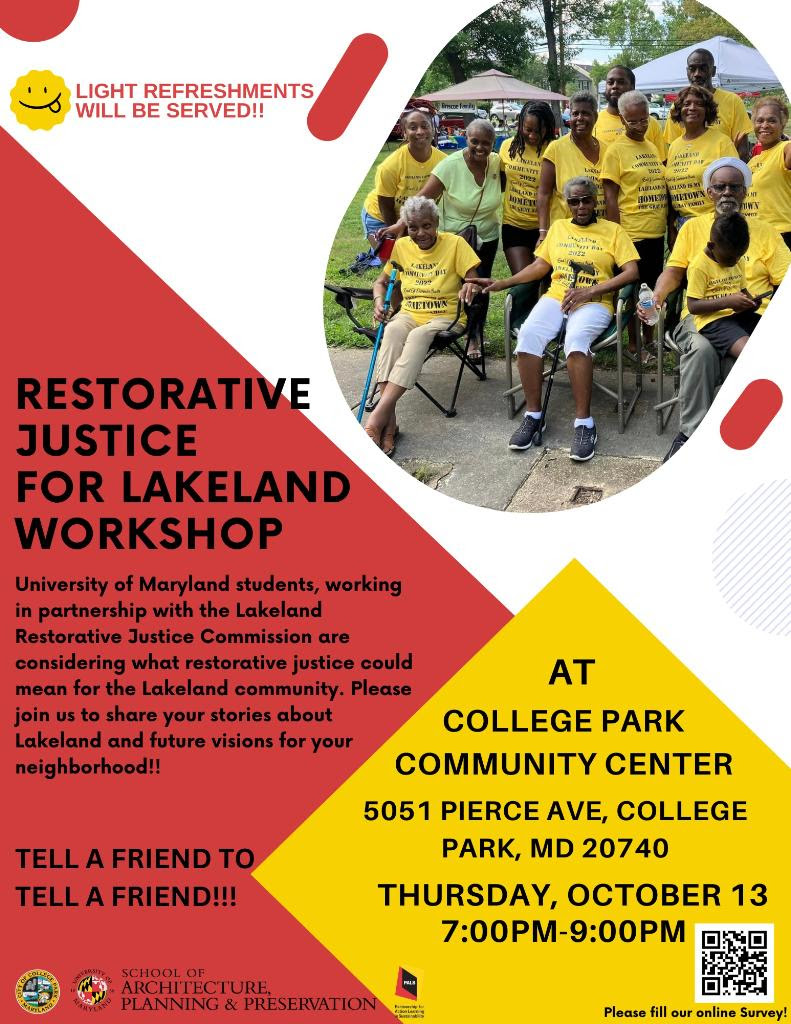
Restorative Justice for Lakeland Workshop, Thursday, October 13th at 7 pm at the College Park Community Center

The Fall 2022 Urban Studies and Planning Studio at the University of Maryland, College Park is
conducting research on the Lakeland Community in College Park. With the theme of restorative justice at the core, this semester’s URSP708 Community Planning Studio will work in collaboration with the residents of Lakeland and the City of College Park to develop scenarios for the future of Lakeland.
The Planning Studio’s focus is on conducting a site analysis of the area, housing, transportation, economic and community development and sustainability. As part of our research, we will also be looking at case studies, plans and policies for similar areas such as Lakeland. Also, we will be meeting with the stakeholders of Lakeland to determine how they envision the area and the type of improvements that they feel will be beneficial to their overall quality of life. At this workshop, they will discuss their findings and receive feedback.

Help yourself and others by ordering from Community Meals  

If you haven’t ordered dinner yet from Community Meals, we encourage you to try it! Not only will you save yourself time and have a delicious dinner, but each meal you make a $12 donation for provides a meal to someone who couldn’t afford the $12 that day. Also, the group tells us the vast majority of their purchases come from Greenbelt residents. We see that as a (friendly) competition. Let’s get those College Park numbers up! Place your order, then pick up your meal(s) at the College Park United Methodist Church between 4:30 pm & 5:30 pm on Tuesdays and Thursdays. Here’s more information from Community Meals:

Community Meals is a food project of College Park United Methodist Church. Each week on Tuesday and Thursday, the kitchen staff prepares a high quality, healthy & delicious meal in the commercial kitchen for the entire community. For every meal you reserve and donate for, the church gives one meal away to a neighbor in need. In the same way, you can reserve and receive a meal without any pressure to donate. Tuesday’s meal is often from Latin America and Thursday’s meal is always halal Afghan cuisine. Try the food and reserve your meal for this week at  https://forms.gle/E3xxNX4cxJpUNsSH8 . Questions? Contact the church office, 301-345-1010.  To follow the weekly menu visit College Park United Methodist Church facebook page.

Community Meals ministry started in 2021 to provide employment to people who lost their job in the restaurant industry due to Covid and to address food insecurity in our community.

City of College College Park Mayor & Council Worksession – October 5, 2022

Haga clic aquí para leer esta publicacion en español.

Comments are by Councilmembers Llatetra Brown Esters and Susan Whitney and are not approved or sanctioned by the City of College Park.

City Manager’s Report 

October 9 -15 is National Fire Prevention Week. This year, the city will focus on fire prevention and what to do if fire occurs. The theme is “Fire Won’t Wait, Plan your Escape.”  The October Community Safety Meeting will feature Ms. Teresa Crisman, Director of Public Affairs of the Maryland State Fire Marshall’s Office and she will discuss safety measure to take in case of fire. The community meeting will take place on Monday, October 10 at 7pm

Councilmember Mackie asked for confirmation about the upcoming shredding event. Mr. Young confirmed the Saturday Cleanup/Shredding event would be held on October 8 from 7:30am – noon. 

Councilmember Kabir acknowledged the Rabies and Microchip Clinic originally scheduled for October 2 was cancelled. He asked when it would be rescheduled. Bob Ryan, Director of Public Services, informed him the city is working on rescheduling the event. 

Amendments To And Approval Of The Agenda 

Councilmember Whitney asked to add to amend the agenda to add consideration of a letter from the City to support a recent notice of proposed rulemaking from the Federal Highway Administration that would establish performance measure requirements regarding greenhouse gas emissions from the National Highway System. 

Proclamations

Indigenous Peoples’ Day 

Breast Cancer Awareness Month 

The Mayor wished our Jewish neighbors a happy new year and a good fast in recognition of Yom Kippur.

Presentation on the business plan for the Community Preservation Trust and review of the MOU between the City and the Community Preservation Trust regarding City funding from ARPA (30) Councilmember Kennedy and Kenneth A Young, City Manager 

Councilmember Kennedy introduced Valerie Woodall, Interim Director of the Community Preservation Trust; Ed Maginnis, legal advisor; and Richard Wagner, Chair for the Community Preservation Trust. They provided an overview of the Community Preservation Trust initiative – to create more single-family home ownership by making home ownership more affordable and accessible and the MOU between the City and the Trust.

Councilmember Kennedy began by mentioning the progress made by the Trust since they last met with City Council. Trust now has almost $14 million in funds and recently received a grant from the Council of Governments (COG). She also shared that an Executive Director has been hired and will start in November; his name is Daniel Cunningham. The Trust worked with the City’s consultants on how to manage the ARPA funding. According to Councilmember Kennedy, progress has been made on the legal work and the Trust has developed a business plan. In addition, the Trust Advisory Committee has been established, and it will eventually become the board of the Trust. 

Councilmember Kennedy mentioned the provision of Graduate Housing will become part of the focus for the Trust. She explained there are currently houses in the community that are already set up for rental. The Trust would like to buy and manage housing with less than 10 units and use it as a source of revenue from the beginning. Councilmember Adams asked if single family houses would be converted into rentals or if the Trust would be purchasing rentals and having graduate students move in. Councilmember Kennedy confirmed the latter. Councilmember Adams asked if graduate students with families would be given preference. Mayor Wojahn asked if students who received subsidized student loans would be given preference. Richard Wagner explained that units would be charge $800 per bed which is considered affordable. Councilmember Mitchell asked if similar programs exist in other communities. Richard Wagner indicated that similar programs did indeed exist in other university communities, mentioning Charlottesville, NC, UC Berkeley and Michigan. 

Councilmember Kennedy indicated that since the last meeting with Council, City housing stock is tightening, and interest rates are on the rise. Councilmember Adams mentioned that the City has little housing stock located in the flood plain but urged the Trust to be mindful not to purchase any of those homes. 

Councilmember Kennedy reviewed the neighborhood priority listing and indicated that Lakeland is the first priority, although they appear lower on the list because the numbers do not adequately reflect the loss of homes due to urban renewal. 

Councilmember Kabir asked that consideration be given to North College Park since many of the homes are affordable in that area. Ed Maginnis acknowledged that fact but emphasized that purchases would be based upon inventory. 

Councilmember Kennedy outlined the five-year plan for the Trust, which includes:

  • Establishment and Startup
  • Testing Strategies
  • Establishing Separate Organization
  • Refinement and Expansion

Councilmember Whitney asked if the $14 million included the $5 million in state funds set aside for affordable UMD graduate student housing. Councilmember Kennedy said it did not. 

Councilmember Kennedy outlined the operating budget including revenue and operating expenses:

Revenue:

  • Sale of properties
  • Monthly Fees
  • Graduate Housing Rental Income
  • Fundraising

 Operating Expenses (estimated at $450,00 Annually):

  • Staffing
  • Executive Director
  • Administration Coordinator
  • Accounting Services
  • Legal Services
  • Marketing
  • Education

Councilmember Rigg asked a procedural question about how matches for homes will be made. He specifically asked if the Lakeland descendants would only be able to live in Lakeland, or if they would be able to live anywhere in the City. Councilmember Kennedy said the director will play a key role in the matching process. She added that Lakeland descendants, like everyone else on the priority list, would be able to live anywhere in the City. 

Councilmember Adams asked if a future homeowner were expected to have a down payment or if the Trust would make the down payment. Richard Wagner indicated the lender would expect the homeowner to make a down payment, but the down payment will be lower than it would be if the buyer were financing 100% of the cost of the home. Councilmember Adams asked if the Trust considered how long an owner should be in the house in order for the purchase to make sense given the fee structures. Mr. Wagner indicated homeowners will need to determine how long they stay. He indicated fees, structures, and appreciation percentage will need to be reviewed each year. Councilmember Adams asked if the maintenance of the roof is maintained by the homeowner or the Trust. Richard Wagner explained the trust will fix the house before selling, but maintenance will be the homeowner ‘s responsibility. Ed Maginnis said the backbreaking expenses Councilmember Adams hinted at might be something the Trust would handle, but the fee would be adjusted for that. The goal would be to preserve the asset for the Trust. 

Councilmember Adams asked what would happen when a home is resold quickly or loses value. Richard Wagner explained that is a risk of the housing market but that the Trust has first dibs at purchasing the home so would have the benefit of not competing on the open market. 

Councilmember Kabir asked, on behalf of a resident, how we are addressing equity issues through this program. Ed Maginnis said, “comfortably when you consider affordability.”  Councilmember Kabir asked about other forms of equity like race. Mr. Maginnis said there are federal laws that ensure non-discrimination in housing. Councilmember Esters added that marketing of the program will be the major tool used to ensure equity, saying the promotion of the program will need to be broad and wide to ensure awareness and opportunity to apply. 

Councilmember Whitney asked if residents would be eligible to use down payment assistance offered through the City and CPCUP to purchase a Trust home. CPCUP Interim Executive Director Valerie Woodall said they’d discussed that with their consultants when designing the Trust and were told that you typically don’t want to have an additional subsidy on top of the Trust. 

During the brief discussion of the Memorandum of Understanding (MOU), City Attorney Suellen Ferguson stated that the City is known as the recipient of the ARPA funds and the Trust will be sub-recipient. As such, the Trust will need to provide reports to the City. Mayor Wojahn asked if the MOU is going to be considered for approval next week. Ms. Ferguson said it would be on the next week’s Council meeting agenda. She said the focus on graduate housing will need to be added to the MOU. 

Councilmember Kabir asked what happens if a house does not sell. Councilmember Kennedy indicated it is a risk. Ed Maginnis explained that with the focus on affordability, they anticipate houses will sell. He emphasized houses will sell at the right price.

Mayor Wojahn asked when we will buy our first home through the Trust. Councilmember Kennedy said the goal is to do so by the end of the year. 

Discussion of a Special Tax District to fund public safety projects in a designated area (45) Kenneth Young, Bob Ryan, Suellen Ferguson, Gary Fields, and Michael Williams 2 

Mr. Ryan, Director of Public Safety, thanked city staff for their help and gave a review of the proposal for the special tax district proposed. Suellen Ferguson indicated that there are two ways to create tax districts. One doesn’t require the approval of a certain percentage of those in the tax district, and one that does require consent. Public safety falls under the category of those that don’t require consent.

This was initially reviewed about 10 years ago. The enabling legislation was approved, but nothing has occurred since that time. Generally, a special tax district is funded by a bond, then the bond is paid off by the taxes that are collected. 

Mr. Ryan spoke of the recommendations made by the Public Safety Task force of the College Park City- University Partnership District 2020 Vision Project and how many of the recommendations were achieved without establishing a special tax district. 

Councilmember Rigg provided some context by saying he asked that this be brought back to the Council as a way to ensure the long-term sustainability of off-campus live camera monitoring. He said funding the program has historically received tepid support by Council, as there has been varied impressions about its effectiveness and a sense that the benefits of the monitoring do not accrue to the City at large, but rather to a small area. He emphasized that the City has heard from SGA, Business Owners and UMD about the importance of this matter. He also made the point that this commercial core provides 80-90% of City revenue and that one could argue that this should be considered part of what they’re paying for.

Councilmember Mitchell thanked Mr. Rigg for bringing this forth and indicated her interested in live camera monitoring in the Crystal Springs neighborhood. 

Councilmember Esters thanks Mr. Rigg for bringing up this discussion. She mentioned the need to consider additional safety measure as the City continues to grow. She expressed her interest in seeing more camera surveillance along the Trolley Trail. 

Mayor Wojahn clarified that what was before the Council was a discussion about a special tax district within the commercial core of the City, which would require those within the area to pay a special tax. Any measures undertaken would need to directly benefit those within the special district. The City can have a distinct discussion about any additional safety measure it would like to undertake and fund. Ms. Ferguson confirmed the Mayor’s comments. 

Councilmember Mitchell thanks the Mayor and Ms. Ferguson for their clarification and indicated that her request and that of Councilmember Esters could be withdrawn for now and discussed at a different time. 

Councilmember Adams thanked Councilmember Rigg for bringing this conversation forward. He said he sees special tax districts as a tool and a way to position ourselves for next year’s budget conversation. He said if we’re hearing from residents that this is a critical issue but we don’t think City funds will cover it, this is a tool we could use. He said we do not currently have live camera monitoring at The Hotel, which is in the proposed taxing district, but we do have live camera monitoring along the Trolley Trail in areas that aren’t in the proposed area. He asked if it might be more practical to have one special tax district just where the live monitored cameras are and a separate tax district for more foot patrols. 

City Attorney Suellen Ferguson said you would have to ensure that each district would provide the funding to cover the extra services the tax is intended to pay for.

Councilmember Whitney asked that staff provide confirmation that all cameras in District 2 for which live monitoring is currently provided fall within the proposed taxing district. She asked Ms. Ferguson to confirm her understanding that, were this special tax district to be established for the purpose of paying for live camera monitoring, the City would no longer be permitted to pay for live camera monitoring in areas that fell outside of that district. Ms. Ferguson confirmed that that was the case. Councilmember Whitney asked that a map be provided that overlays the special taxing district and the current live camera monitoring. Mr. Ryan said that could be done.

SGA liaison Valerie Graham thanked Mr. Rigg for bringing this idea forward, given the cameras make students feel safer. She also mentioned previous discussions about University of Maryland perhaps contributing to the cost for live camera surveillance through increased student fees. 

Councilmember Rigg indicated that the Downtown College Park Management Authority (DCPMA) contributes funds for foot patrols along Baltimore Ave in the downtown area. Mayor Wojahn asked if the DCPMA see live camera surveillance as beneficial as opposed to foot patrols. Councilmember Rigg said that DCPMA previously sent a letter expressing their enthusiasm for including funds for live camera monitoring in the budget. 

Councilmember Rigg asked Mr. Ryan what would happen in the case of an incident occurring outside of the tax district. Mr. Ryan said that contract officers have to abide by County regulations, and the closest officers, regardless of whether their beat was the special tax district, would need to respond. 

Councilmember Whitney asked about the Police Ambassador program and why that was discontinued. Mr. Ryan shared that Senator Rosapepe brought this idea from Philadelphia. After the pilot, CPCUP and the City no longer wanted to fund the program. Councilmember Rigg said there were Councilmembers who did not want to contribute to the program because they thought it provided a disproportionate benefit to the downtown area. 

Councilmember Whitney asked if an analysis of the success of the pilot had occurred, and Mr. Ryan said it had not.

Councilmember Mitchell asked Mr. Gary Fields, Director of Finance, if he had been able to consider how this special tax district would be managed if it moved forward. Mr. Field explained he had not considered it as of yet and said it would need to be reviewed further. 

Mayor Wojahn added that the City would need to consider the impact of imposing more taxes on the small businesses that exist in the area proposed for the special tax district. Follow up discussion of the Report from the Redistricting Commission (30) Bill Gardiner, Assistant City Manager 9:10 4

Mr. Bill Gardiner, Assistant City Manager, brought the discussion forward and said that concerns were expressed the previous week about Districts 1, 3, and 4. He said that during the Commission’s meeting on Monday, October 3, they indicated they wanted to respond to Council’s concerns but needed Council to provide guidance on what they would like to see. The Commission also voted to finalize the report to the Mayor and the Council, saying they stood behind their analysis and proposed maps. Mr. Gardiner said a hard copy would be provided as soon as possible. 

Mayor Wojahn clarified that tonight’s purpose is to give additional clarification to the Commission, not to make a decision tonight. Mr. Gardiner confirmed that was the case.

Councilmember Kabir said the number of residents who sent emails about redistricting reflects how many are truly concerned about the issue. He asked that the Redistricting Commission keep together the neighborhoods currently in District 1. 

Councilmember Adams stressed the need to keep the neighborhoods together as much as possible. Suellen discussed the two factors that are elevated, population and actual voters. 

Councilmember Esters acknowledged the concerns of those who have lived in the city for many years and recognized that change is difficult. She indicated we are not the same city we were twenty years ago, nor are we the same city we were ten years ago, as evidenced by the recent census data. She said that we need to be careful in making decisions about this process based upon the desires expressed by residents. Rather, we need to focus on the data. She went on to say we asked the Commission to do a job and they focused on the data. Per our previous meeting, we were to consider the variance associated with actual voters, so let’s do that. She also added that a shift of district boundaries should not be seen as punishment. 

Councilmember Mitchell asked that Council colleagues understand that maintaining two districts directly impacts Districts 2 and 4.  She has concerns about the shift in district 4, but she will be a team player and do what needs to be done in order to move things forward. 

Councilmember Kennedy pointed out that in the proposed maps, District 2 would include up to six civic associations, unlike any other district. She believes this needs to be considered as we determine districts. 

Councilmember Mackie said, like her colleague Councilmember Mitchell, she would be a team player and do her best to serve the residents of the city. 

Councilmember Rigg said we need to be careful of looking like we are picking our voters. He reminded Council of the letter written to the county to speak out against them choosing their own voters. We need to avoid doing what we spoke against. 

Councilmember Whitney talked about her confusion about why residents with common goals would see it as detrimental to their interests to have representation across districts, as that would only increase the number of councilmembers expressly charged with working toward said goals.

Councilmember Esters said she agreed with the use of 2023 data for calculating population, saying it just made sense. She expressed her feeling that there is something fundamentally wrong with going through this process and asking that only two districts remain the same and acknowledged Councilmember Mitchell’s comment that maintenance of Districts 1 and 3 directly impacts Districts 2 and 4.  Despite that, she, too, will be a team player and will do what needs to be done to move this process forward.  She thanked Councilmember Kennedy for pointing out that based upon current maps, District 2 could have up to six civic associations to serve. She joked that her colleague should not worry, as she and Councilmember Whitney will coordinate everyone’s schedules so they might assist and will request personalized scooters to cover their district. She concluded by saying that the city’s growth, as evidenced through this process, suggests that we may need to reconsider the structure of the City Council. She believes the current structure may have run its course and may not be feasible moving forward. 

Councilmember Mitchel agreed about the use of 2023 data considering that we have other developments in progress. She said if we come to meetings and say we’re going to work together to do what’s right for the City, then we go into our district and say something different, it causes confusion and division. She said we’ve come a long way as a body and need to keep moving forward, not backwards. She said whatever personal feelings councilmembers have about the plan, she urged them to contain them when considering how to educate their residents. She then asked how the timeline would be affected should we not come to an agreement on 10/18. Ms. Miller said it would depend on how quickly decisions were made after that. She said if Council were only asking the Commission to tweak an existing map, that would only take a couple of extra weeks and would not cause issues.

Councilmember Whitney said after we finish this process it would be helpful to have information that shows us what the maps would look like if we did not include actual voters in the criteria. 

SGA Liaison Graham attended the Commission meeting on October 3 and explained the Commission said they would be willing to create new maps if given the parameters from the Council.

Mayor Wojahn said that the consultant’s Plan B maps met the criterion and could be tweaked a bit. 

Councilmember Rigg asked that we consider at least one map from the Commission. 

Mr. Gardiner said he would try to summarize the discussion and give the Commission guidance. Mr. Gardiner asked if we wanted to consider adding flexibility to the criterion right now. The Mayor said Council wanted to direct the Commission to consider a 7.5% variance for voters, rather than the 5% initially considered. 

Consideration of a sponsorship request from Holy Redeemer School’s Home and School Association for the Monster Dash 5k and 1K Trick or Trot in the amount of $2,500 

Mr. Fields presented a grant request from Holy Redeemer School. The organization has received a previous grant from the City. The only concern was that funding not be used for religious purposes. 

Ms. Tuttle, representative for Holy Redeemer School, thanked Council for their consideration of the grant. The Council voted to move into Special Session. The motion to approve the grant was made by Councilmember Mackie and seconded by Councilmember Kabir. Council unanimously approved the grant, then unanimously voted to exit Special Session. 

Requests for/Status of Future Agenda Items Mayor and Council 

Councilmember Kabir asked for a review of the charter for redistricting. He apologized to Mr. Young for not discussing it with him prior to submitting request, as required. Councilmember Kennedy asked that it be taken up after the current redistricting process is completed.

Councilmember Mitchell agreed that we should complete the current redistricting process before this is discussed. 

Councilmember Whitney asked for the agenda item to be broader in scope given Council’s discussion. 

Mayor Wojahn asked for discussion to be had among Council member to broaden the scope of the agenda item and then have the request brought back to Council. 

Mayor and Councilmember Comments Mayor and Council 

Mayor Wojahn mentioned that the mayor of Bloomington, Illinois reached out for support as they put in their bid to host the next World Expo. 

City Manager’s Comments 

No comments.

MEETING ADJOURNED 

Click here to see the Work Session agenda for October 5 , 2022
Click here to view the Mayor and Council Work Session held on October 5, 2002
Click here to access the Mayor and Council Meeting agenda scheduled for October 11, 2022 

City of College Park Council Meeting – September 27, 2022

Haga cliq aquí para leer esta publicación en español.

Comments are by Councilmembers Llatetra Brown Esters and Susan Whitney and are not approved or sanctioned by the City of College Park.

 ANNOUNCEMENTS/COMMENTS 

Councilmember Kabir mentioned the Homeowners Tax Credit Program and informed residents of the pending application deadline of Saturday, October 1. He added that homes in the area are appraising for much higher values and that the tax credit could defray costs.  

Councilmember Kennedy invited residents to attend the Branchville Volunteer Fire Department (BVFD) Open House on October 9.  

Councilmember Esters mentioned Prince George’s County’s county-wide community beautification effort (Growing Green with Pride) that will take place on October 15 from 8am – noon. She acknowledged it is the same day as College Park Day but encourage those interested to participate in a project and then attend College Park Day, which begins at noon. 

Councilmember Rigg spoke of the fundraiser he coordinated to raise funds for school uniforms for Afghan refugees met its fundraising goal within 5 days of launch, and he thanked the College Park community for its generosity and welcoming spirit. Mayor Wojahn thanked Councilmember Rigg for his effort.

Councilmember Mackie requested everyone to add Good Neighbor Day (GND) to their calendars. The event will be held on Saturday, November 12. 

Councilmember Mitchell mentioned the that she’s leading a project for Good Neighbor Day to assist Attick Towers. She also thanked Code Enforcement and Contract police for their assistance with an incident that occurred in College Park Woods over the weekend and commended them for their collaborative response.

Mayor Wojahn mentioned the Latinas in Aviation Event to be held at the College Park Aviation Museum all day on October 1. He explained the event is based on a book of the same title written some years ago. The event will include a fly-in. Detailed Information is available on the museum website

Adrian Andriessens mentioned Mental Health Awareness Week at University of Maryland from October 1- October 8.  

CITY MANAGER’S REPORT 

Kenny Young announced his first-year anniversary working for the City of College Park and expressed appreciation for his experience, thus far. Mr. Young indicated October is Breast Cancer Awareness mMonth, andpins have been given out for Council, staff, and others. He shared that Maryland National Capital Park and Planning Commission (M-NCPPC) will be holding meetings to take public comments for their budget for the 2023 fiscal year, the first meeting is scheduled for October 4, and more information can be found at their website at www.pgplanningboard.org.  Mr. Young concluded by sharing details about the upcoming City Clean-up Saturdays to be on the 10/8 and 10/22. 

Councilmember Mitchell asked Mr. Andriessens to share the information about the UMD’s Mental Health Week. 

ACKNOWLEDGMENTS 

Mayor Wojahn acknowledged former councilmembers Robert Day and Stephanie Stullich.

PROCLAMATIONS AND AWARDS:    

Mayor’s Monarch Pledge 

National Code Compliance Month 

AMENDMENTS TO AND APPROVAL OF THE AGENDA 

There were noamendments to the agenda. 

 PUBLIC COMMENT ON CONSENT AGENDA AND NON-AGENDA ITEMS 

Stephanie Stullich (College Park Resident) – said that it is well known the noise and loud parties that occur throughout the city, including the areas of Old Town and Calvert Hills. According to Ms. Stullich, the City has been dealing with this issue for 70 years, not enough progress has been made, and what has been done is not effective. She said when code enforcement officers drive up and park their cars to measure the noise, they’re spotted and the party quickly quiets down. When there are multiple parties, code enforcement staff are overwhelmed. She believes there are two policy changes that can be made: Noise officers should park around the corner and be non-obtrusive; and their objective should be to take the noise decibel readings at all active parties first, and then go around to shut down the parties. 

Mayor Wojahn thanked Ms. Stullich for her suggestions and indicated that he looks forward to working with the community to help mitigate these issues which he understands are especially challenging this year. 

PRESENTATION:  Report from the Redistricting Commission 

Mr. Robert Day, Chair of the Redistricting Commission, introduced the members of the commission and reviewed the presentation

He explained that the City Charter requires review of the population ever decade once the census has occurred. A determination is then made regarding the need to redistrict. Since the Commission began their current review, there have been a total of nine public meetings including two meetings where the draft reports were presented. 

Suellen Ferguson, City attorney, talked about the Commission’s charge. She explained the Council decided to have a commission and came up with the charge in Ordinance 22-2-04 which stipulates two criteria to review, the population and actual voters. Specifically, the sum of the population and actual voters shall be substantially equal in each district. According to Ms. Ferguson, if the Commission has reliable evidence that the Census doesn’t reflect all residents, it can add or subtract additional population based on that evidence. She mentioned concern that race was not considered and added that other criteria can be considered when redistricting, although the two primary criteria of population and actual voters must be at the forefront. The Supreme Court’s guidance looked primarily at population. 

DW Rowlands, Redistricting Commission Vice Chair, provided addition perspective. Rowlands shared that there are currently twice as many voters in District 1 than found in the districts with the lowest actual voters. Looking at population, the Commission found that District 1 is 7.2% smaller than it should be versus District 4 being 8.2% bigger. District 3 would need to become smaller, and District 1 would need to become larger. Rowlands informed Council that Map Proposal 1 was based upon the 2020 Census numbers + actual voters in each District and said that given the structure of the city, it is nearly impossible to get the numbers of voters to be similar in all districts. While reviewing specific maps, DW Rowlands provided the following insight:

  • Map Proposal 1 – Population error was within 5%  
  • Map Proposal 3A – maintains Calvert Hills and Old town and splits up the south district student housing 
  • Map 3B– In order to bring the student housing populations together, Old Town was brought into District 2
  • Map 3C – Brings District 2 across Route 1 and includes the Mazza apartment complex. 

Jordan Dewar, member of the Redistricting Commission, provided additional insight. He explained that the consultant maps divided neighborhoods more than those done by the commission. The Commission sought to identity some commonality among the districts. The Commission requested more clarity and a possible change to the criteria moving forward. The difference between voter turnouts during midterm versus presidential elections was mentioned during the discussion. 

Robert Day thanked the Commission for their work with a special mention of those Commission members who looked at the numbers. He explained that the Commission tried to keep neighborhoods together as much as they could. He said this was not an easy task, unlike the previous times he participated in the process. 

Mayor Wojahn thanked the Commission for their work. He asked why they chose not to use the consultant maps. Mr. Day reiterated the consultant maps were not chosen because of the manner in which neighborhoods were broken up. He explained the Commission’s consideration of major roads in the City and attempts to ensure that changes had the least impact. 

Mayor Wojahn expressed concern about the east/west break up of North College Park and the manner in which South College Park was broken up into three districts. He acknowledged the concerns about breaking up student populations, but said in order to accomplish our task and evenly divide voters, they will need to be broken up throughout the districts. 

Councilmember Mitchell said it would have been helpful to have all maps for review to understand and be able to explain to her residents. 

Mr. Day explained that the voters identified as part of the process were actual voters versus eligible voters. 

Councilmember Mackie asked how the number of voters were calculated acknowledging that the County voters rolls are not always accurate. DW Rowlands said City Staff cleansed voter data of personal info, then gave it to the commission. The Commission removed duplicates of the same person. If a person was listed at 2 different addresses across 2 elections, the Commission counted them at their address for the most recent election.  City staff geocoded the data that was used. 

Councilmember Kabir thanked the Commission and asked a procedural question. He said the criterion indicates we need to be substantially equal but does not give us a hard number and sought clarity. Ms. Ferguson explained the deviation of more than 10% for factors not meeting criterion. She added, you cannot have hard numbers because you do not have the exact population. She went on to clarify that the concern about County voter rolls has to do with taking those who are deceased off of the rolls, but there has not been an issue with the numbers of actual voters. If you were only to look at population you can divide it up many ways, but population is generally not the only thing that is considered. 

Councilmember  Kabir thanked the Commission for the maps they provided and questioned other options to open the discussion to the community, including allowing others to create maps like the City of Takoma Park had done. Mr. Day said Takoma Park had taken six months to develop that process, time College Park’s Commission did not have.  

DW Rowlands added that one major challenge was criterion. The City’s Commission did not have the data to draw maps until mid-July, and Rowlands believed that Takoma Park was using purely raw census data and did not have the added complications of considering numbers of actual voters and a rapidly growing population due to new development. Those factors make College Park’s situation more complex.

Councilmember Kabir asked if more public comments can be made so the Commission can make additional tweaks. Mr. Day indicated that decision would need to come from the Council. 

Councilmember Kabir said there has been a major change to the district boundaries. He indicated that District 1 includes three neighborhoods and asked for District 1 to keep the three neighborhoods together and suggested ways to do so. 

DW Rowlands responded by saying that all of the districts grew. 

Councilmember Kennedy explained she did not take into consideration there was a hard number when we considered voters. She asked if we could consider increasing the variation of voters. Ms. Ferguson explained that the Commission could only consider what is. She referenced the case law (Dubois vs. City of College Park) requiring voters be included in College Park’s redistricting process. 

Councilmember Kennedy expressed concerns that undercounting was more than likely in student housing. DW Rowlands said the Commission used the bed count for the residence halls to account for any undercount. Student apartments that rent by the bed have separate leases per bed and are generally at full capacity, so they assumed full capacity. For other housing, they had to rely on the data from the census. 

Councilmember Kennedy asked if it was 100% certain that it’s too late to change the charter before redistricting.

Janeen Miller, City Clerk, gave an overview of an adjusted timeline if the charter were changed and asked that not be done to staff because it would create a strain since they begin working on election materials in April and need to know the districts. 

Councilmember Whitney asked for clarification about the 10% differential the Commission applied to the total criterion (population + actual voters) and asked if it legally applied to anything an entity defined as part of the criterion. Suellen indicated that 10% comes from federal case law as it relates to population, but not other criteria. Councilmember Whitney then asked if that meant that the variation for other criteria could be adjusted without the need to amend the Charter. Ms. Ferguson reiterated that population is the only criteria that must be maintained at the 10% differential. 

Councilmember Rigg thanked the Commission for their work and asked about the process order for all criteria. Mr. Day said they first noted their numbers and tried to make adjustments. Councilmember Rigg talked about what he considered the core of District 3 which includes Old Town, Calvert Hills, Yarrow, and College Park Estates. Mr. Day expressed the difficulty he had in keeping his mouth shut about shifts with District 3 but said the numbers were the major driving force. DW Rowlands said there were several ways in which to evaluate what constitutes the core of a district. The Commission considered the most politically relevant definition was the population that has been voting in that district. They analyzed which fraction of voters would remain in that district and asked if they a) took a majority of voters out of it or B) diluted it such that the majority of voters in that district would, after the change, no longer constitute the majority of the voters. Our maps didn’t change that. 

Councilmember Rigg asked if the analysis would have been different if it the number of actual voters had been base on the 2020 Presidential Election, saying voting in presidential elections would represent the high water mark. Rowlands said voter participation in City elections seemed more relevant.

Councilmember Rigg asked why the maps keeping District 3 together were not included. Mr. Day reiterated that the consultant’s maps had a greater negative impact on the city. 

Councilmember Adams pointed out that in the 2023 maps, District 3 will be much bigger by population. He suggested those maps almost mask the number of voters by adding population, saying he thinks the one person, one vote principal is violated, especially when you throw in those buildings that have just broken ground. He asked 

Mayor Wojahn referenced Proposal B (consultant map) as a map that may help in keeping District 3 together without breaking up District 1 as much as the Commission’s proposals do. He asked if those maps could be brought back into the mix.  Rowlands said that they are the mix in that the Council is free to decide which maps they wish to consider. 

PUBLIC HEARINGS:

Ordinance 22-O-08, An Ordinance Of The Mayor And Council Of The City Of College Park Authorizing The Acquisition Of Certain Property Located At 5100 Roanoke Place, College Park, Maryland, For A Public Purpose. 

CONSENT AGENDA 

22-G-131 Approval of minutes from the September 6, 2022, Work session, the September 6, 2022, Special Session, the September 13, 2022, Regular Meeting, the September 20, 2022, Work session, and the September 20, 2022, Special Session  

The consent agenda was unanimously approved.

ACTION ITEMS 

22-G-132 Consideration of County Legislation CB-97-2022 – An Ordinance Concerning Zoning – Zones and Zone Regulations – Base Zones – Expedited Transit – Oriented Development – Terry Schum, Director of Planning    

Councilmember Mackie made the motion to approve a letter to County Council Chairman Hawkins in opposition to County Legislation CB-97-2022. She said it’s important to oppose what is happening in County Council. Councilmember Mitchell said speaking out shows that College Park is a leader is taking control over what happens to it. Councilmember Rigg said the new countywide zoning sets a level of quality and uniformity and that he didn’t understand why the impulse to weaken it exists. The Council voted unanimously to send a letter opposing the proposed County ordinance.

22-O-08 An Ordinance Of The Mayor And Council Of The City Of College Park Authorizing The Acquisition Of Certain Property Located At 5100 Roanoke Place, College Park, Maryland, For A Public Purpose   

Councilmember Whitney made the motion to approve the acquisition and Councilmember Esters seconded. Councilmember Whitney said the property would be a quality addition to the Berwyn neighborhood and looks forward to what the community decides to do with it. The Ordinance passed unanimously.

GENERAL COMMENTS FROM THE AUDIENCE 

No general comments from the audience. 

 MEETING ADJOURNED

Click here to see the Council meeting agenda for September 27, 2022

Click here to view the Mayor and Council meeting held on September 27, 2002

Click here to access the Mayor and Council work session meeting agenda scheduled for Wednesday October 5, 2022.